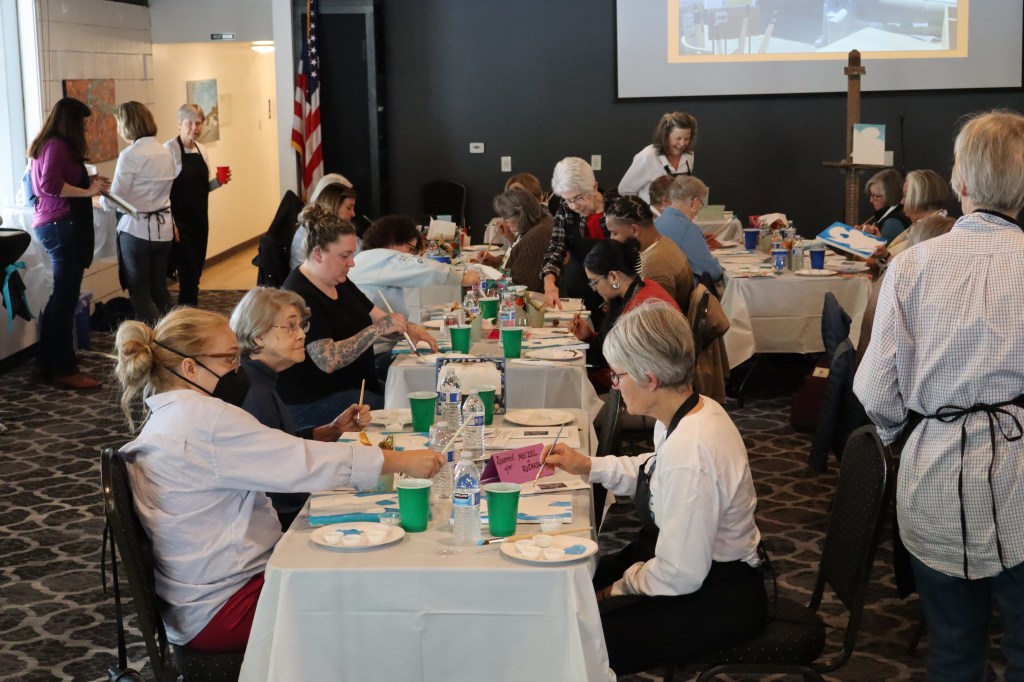
Guests are led in creating a painting at Make It Happen for Yolo County’s Paint for a Purpose fundraiser last spring. Tickets are now on sale for this year’s event on Feb. 7.
To raise funds for Yolo County transition age youth
Fundraiser to benefit nonprofit Make It Happen for Yolo County
(From press release) Tickets are on sale for the 3rd Annual Paint for a Purpose happening Feb. 7 and benefiting nonprofit Make It Happen for Yolo County, which provides under-resourced transition age youth – many moving out on their own after foster care or homelessness – with furniture, household goods and essential items needed to establish a first home. Local artist Joanne Andresen will lead guests in creating a painting as they enjoy beverages, light fare and door prizes. The event will take place 2:00-5:30 p.m. at the Unitarian Universalist Church of Davis, 27074 Patwin Road in Davis. Cost per ticket is $75, and tables of four are available for $300. Seating is limited. To purchase tickets: www.MIHYolo.org.
“This event is such a beautiful opportunity to gather as a community to create artwork while also supporting the resilient youth in our community who are moving out on their own with very few resources,” said Cathi Schmidt, executive director, Make It Happen for Yolo County. “Paint for a Purpose will help us raise valuable funds to ensure every youth we serve this year has the items and support they need to create a home and successful path into adulthood.”
[The following letter to the Davis City Council was shared with the Davisite for posting]
January 12th, 2025 To. Mayor Neville and Council Members Fr. David J Thompson Re. The most recent Village Farms Affordable Housing Plan
The latest iteration of the Affordable Housing Plan for Village Farms is still missing critical elements. Therefore, it should not be accepted by the City Council.
* I Have placed the Regional Housing Needs Allocation (RHNA) numbers in a table at the end of this article. Clearly, Davis is most deficient in creating Very Low Income (VLI) and Low Income (LI) units
As an interested observer, it has been difficult to keep up with the numerous changed affordable housing plans for VF brought forward at the very last minute.
I encourage the City Council to require the VLI and LI affordable housing plan to be specifically set in VF as close as possible to Covell Blvd. Please switch the MOD site to the most northerly of the three parcels. All the major competitive sources of funding for affordable housing are based upon a points system. Usually, each applicant scores 100 points and the winning applicants are those applicants which gain more in tie breakers. High points are for example given for categories with a quantified proximity to existing bus routes and to shopping centers with a supermarket. These points are critical specifically to the projects set aside for the categories of Very Low Income (VLI) and Low Income (LI). These projects will have a far better chance of being funded when set adjacent to Covell Blvd.
Another point to make is that the specific sites to be designated for VLI and LI should be large enough (min 4 acres) to be built in two phases. The second phase will score higher when added to an existing phase because of increased scale and reductions in management, administrative, legal, architectural fees and in building costs. A community building and offices built in phase one will not be needed for phase two. This also frees up land in phase two to be used for income earning additional housing units rather than the additional non-earning expenses of a community building. Otherwise, each smaller site will have to have a community building and separate staffing and duplicate costs for the expense categories listed above. Every saved penny per unit wins additional award points in the competitions.
If I am correct there will be no for sale single family units affordable to 80%-120% income category. This is a measureable weakness in the range of affordable housing products in the present application.
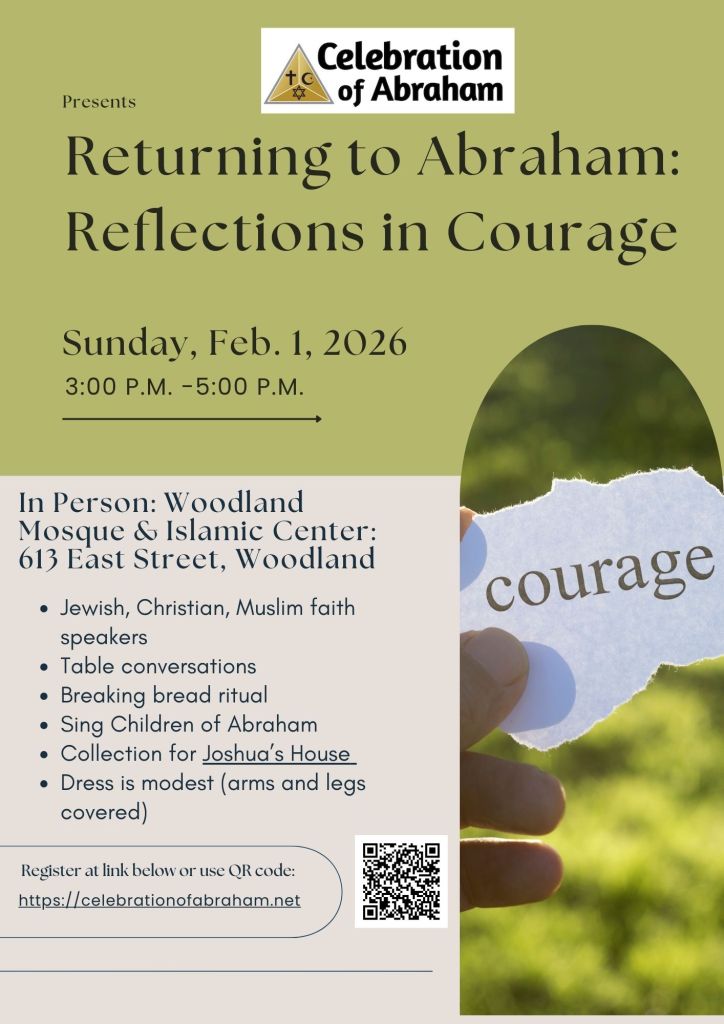
(From press release) The Celebration of Abraham was founded after 9-11 with the mission of creating a welcoming tent for all people in our community to nurture a sense of compassion, respect, and appreciation and to foster learning and understanding among the three Abrahamic traditions. In 2003 the Celebration of Abraham assembled for the first time. We met in Woodland, at Holy Rosary Catholic Church. This year the Celebration is excited to announce that we will again meet in Woodland, on Sunday, February 1, 3-5 PM, at the new beautiful Woodland Mosque and Islamic Center at 613 East Street in Woodland with the theme “Returning to Abraham: Reflections in Courage.” As we face these challenging times, we felt a need to return to the strengths our religious traditions can provide.
Our speakers will be Rabbi Leah Julian, Director of Education and Youth, Congregation Bet Haverim; Father John Boll, Diocese of Sacramento, (retired); and Imam Riaz Ahmed Qadri of the Woodland Mosque and Muslim Center. As they present the stories of Abraham’s faith and courage, we will provide everyone with cards so that they can write down the questions talks raise for them. After the presentations, our speakers will address the questions that participants have raised. We will then spend time in table discussions on how we might individually address the challenges, uncertainties and fears we are facing.
As in previous years, we will share in a ritual hand washing and sharing gluten free bread. Each year, the Celebration collects a free will offering for a non-profit that provides needed service to our community. This year we are collecting for Joshua’s House, a hospice home for the unhoused in Sacramento. The program will close with Randy Ferris leading us in an Acapella version of “Children of Abraham.”
To help us plan, we hope you will preregister at https://celebrationofabraham.net. Please dress modestly (arms and legs covered) as we will be at the mosque, a sacred space.
Draft of table question
The speakers from the Jewish, Christian and Muslim traditions have presented stories of how Abraham courageously met challenges in the face of fear, uncertainty and sacrifice. Consider when you have faced a situation that required courage or trust? What helped you through it?
The California Environmental Quality Act (CEQA) requires an Environmental Impact Report (EIR) to examine the potential impacts of a range of reasonable alternatives to the proposed project and evaluate the comparative merits of the alternatives. Under CEQA, the purpose of studying alternatives is to allow meaningful analysis and comparison of alternatives that could reduce significant environmental impacts as compared to the proposed project.
The alternatives must be feasible, meet most or all of the project objectives, and avoid or substantially lessen one or more of the project’s significant impacts. Alternatives are generally evaluated in a qualitative manner rather than to the same degree of exactitude as the proposed project. A “no project” alternative is always included. The “no project” alternative for a project that would develop vacant land would in most cases be the “Environmentally Superior Alternative (ESA),” but not building the project would fail to achieve any of the project objectives.
As a result, the alternative that best avoids or mitigates the most impacts is typically identified as the ESA, but the lead agency (the City of Davis in this case) is not obligated to substitute this alternative for the proposed project. In fact, because alternatives are generally analyzed qualitatively, a lead agency could not approve an alternative consistent with CEQA unless that alternative was also analyzed at the project-specific (i.e. detailed) level, such as the Biological Resources Preservation Alternative (BRPA) for the Village Farms project.
Alternatives are selected after the project’s impact analysis has been completed and the project’s potential impacts to the environment are known. This is a logical sequence because it is impossible to know if an alternative would produce fewer impacts if the potential project’s impacts are not yet revealed, just as a doctor cannot consider alternative treatments for a patient before the ailment and its source are known.
In my experience working with EIRs since 1984, once the impact analysis has been completed, there typically will be a meeting among the EIR consultant, the client (in this case, the City of Davis) and potentially the project proponent (in this case, the developer). For a project such as Village Farms, the EIR consultant and city planning staff would use their professional experience and knowledge of the area and CEQA to devise a range of reasonable alternatives, with which the project proponent may or may not concur. In other words, the selection of alternatives is an objective process based on impartial judgment and professional experience. It should not influenced by political or financial considerations.
A knowledgeable but now retired land use consultant once told me that in his long experience, impacts to biological resources, traffic, and air quality tend to be the primary factors that influence the identification of alternatives. Typical alternatives might include any or all of the following:
The same footprint or area but with fewer units (meaning lower density).
A smaller physical footprint but with the same number of units, which would typically avoid impacts on sensitive biological resources on the property.
A reduced project area footprint that includes the same number of housing units, but with a different mix of housing types.
A lower number of housing units on a smaller footprint.
Developing the project at an entirely different location, if acquiring such land for an alternative is feasible.
WHEN/WHERE: TOMORROW: Saturday, Jan. 10 • 11:30am-1:00pm: Heritage Plaza, 710 Main Street, Woodland • 1:00-2:00pm: Davis Central Park, 401 C Street, Davis
WHAT: Residents from across Yolo County will gather in Woodland and Davis for ICE Out For Good protests against ICE and the recent murder of Renee Good in Minneapolis along with all lives lost to ICE violence. The events will take place alongside protests across the country and will include protest signs, speakers and more.
On Wednesday, Renee Good, an American citizen, was killed by Immigration and Customs Enforcement (ICE) in Minneapolis, Minnesota. This killing is part of a broader pattern of unchecked violence, impunity and abuse carried out by federal immigration enforcement agencies against members of our communities. Indivisible Yolo is joining a coalition of groups across the country for a coordinated Ice Out For Good Weekend of Action to demand accountability, honor the life lost and make visible the human cost of ICE’s actions.
[Note: a shorter version of this article appeared in today’s Davis Enterprise. This longer version gives additional details and background for Commissioner Rowe’s votes.]
By Greg Rowe
Introduction
The planning commission’s marathon December 17 meeting concluded with two recommendations to city council for the proposed Village Farms development: certify the project’s Environmental Impact Report (EIR); and approve the project for a Measure D election. It is expected that by January 20, Council will consider those recommendations and decide whether to place the project on the June ballot. (January 20 is the last meeting date when Council can meet the County’s deadline for June ballot measures.) Voter approval would be followed by a general plan amendment, pre-zoning, and annexation of the site from Yolo County.
I voted against certifying the EIR because of what I am convinced are serious procedural irregularities, based on working with the California Environmental Quality Act (CEQA) since 1984. I likewise declined to support the project because I am convinced its location within a flood hazard zone would compromise the safety of Davis residents within Village Farms.
What is Village Farms?
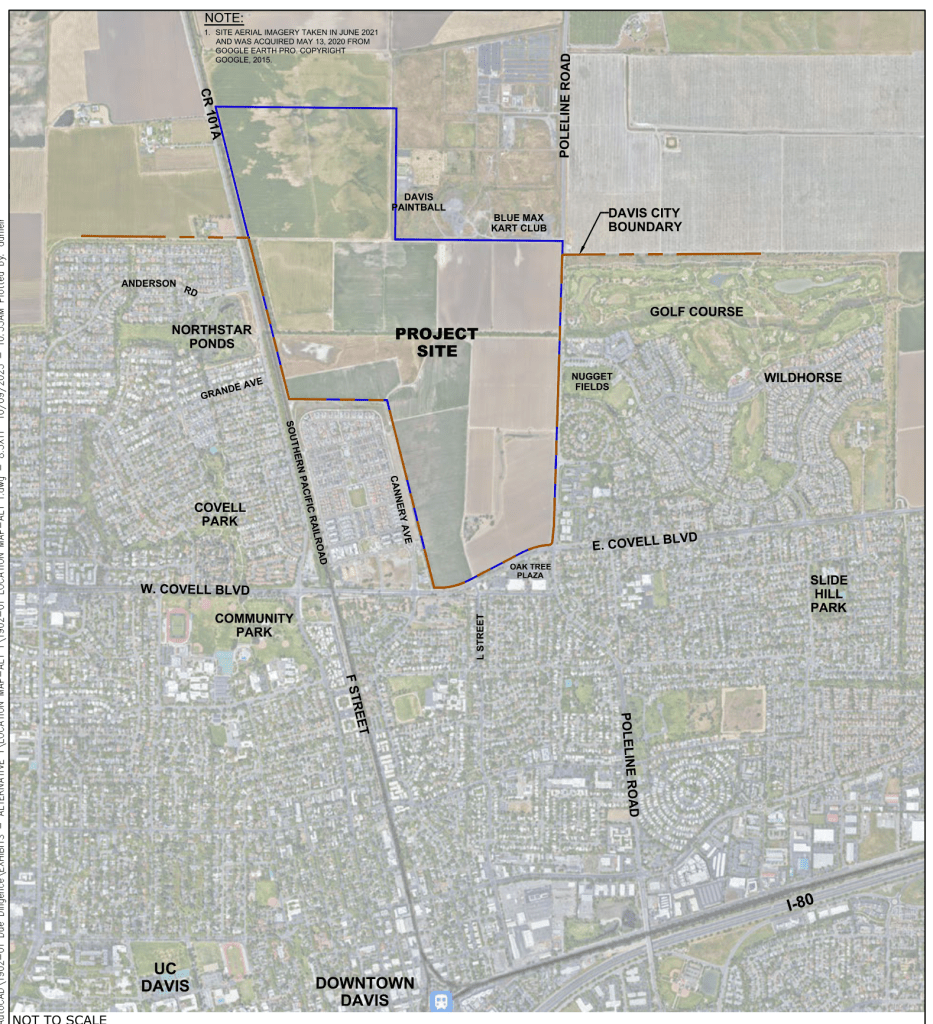
The developer proposes to build 1800 market rate and affordable homes of various types, ranging from apartments to single-family detached homes. There would also be parks, open space, a protected 47-acre wetland habitat, a site for pre-K daycare, and a small land dedication to the City of Davis for public facilities. The property comprises 497 acres situated at the intersection of Pole Line Road and Covell Blvd, extending westward along Covell and north along Pole Line to the Blue Max Kart Club and Davis Paintball.
The proposed project would border The Cannery neighborhood, wrapping around that community on its north side and extending northward along the east side of F Street. A major City of Davis drainage course (“Channel A”) flows west to east through a portion of the Village Farms site. The developer has stated that grading and infrastructure installation would take about two years, and buildout would occur in four phases lasting an additional 15 years. Pursuant to the draft Development Agreement (DA) between the developer and the City, the developer would install grade-separated bicycle and pedestrian crossings of Pole Line Road and F Street.
Climate Change and Floods
The Central Valley has long experienced devastating floods, as described in historian Robert Kelley’s seminal 1998 book, Battling the Inland Sea. The risk of flooding is now much greater because of a warming climate and a higher population that would be exposed to flooding caused by large and intense storms.
The Partially Recirculated Village Draft EIR has included the five alternatives in Chapter 7, “Alternatives Analysis” from the original DEIR. This opens that door to comment on adding the “reduced footprint” alternative proposed by Davis citizens requested at the Dec, 12, 2023 City Council meeting. This alternative should have been included, which is similar to the “environmentally superior” reduced footprint alternative which was included in the previous Covell Village Draft EIR. Because this “Alternative Analysis” chapter is included in the Partially Recirculated DEIR, comments on the Alternatives Analysis are now “in-scope” until Jan 2nd at 5 pm. That means the city has to evaluate and respond to all significant points you make related to this topic. It’s your right under CEQA. Here’s a definition of what makes a point significant:
“A “significant point” is a substantive comment that raises a material environmental issue or identifies a specific deficiency in the EIR’s analysis, conclusions, or mitigation such that the agency must address it with a reasoned written response grounded in the record (not a mere acknowledgment).”
Because the Village Farms process has been so aberrant and fast-tracked from the beginning, our public input has been compressed timewise. Because all of this was piled on during the holidays, including back-to-back public meetings, we now only have until this Friday Jan. 2, at 5pm to submit our comments to ask for this reduced footprint alternative.
In an earlier article, I mentioned that there was a recirculated (and partial) Draft Environmental Impact Report (DEIR) for the Village Farms proposal, necessitated by “new information” related to the City’s overall Wastewater Treatment Plant (WWTP) capacity.” I also noted that the City was taking public comment on the recirculated (partial) DEIR, with comments due by 5 PM, January 2. As that day is very soon upon us, I thought I would share my own comments here.
Anyone thinking of submitting their own comments should note the following:
“Pursuant to CEQA Guidelines Section 15088.5(f)(2), the City of Davis directs that public comments must be restricted to the newly circulated information contained in this document related to wastewater treatment capacity. The City is not obligated to respond to any new comments that are directed to the portions of the Draft EIR that were not revised and are not being recirculated in this document.”
Comments must be directed to:
Dara Dungworth, Principal Planner City of Davis Department of Community Development 23 Russell Boulevard, Suite 2 Davis, CA 95616 ddungworth@cityofdavis.org
My public comments (submitted earlier today) are as follows:
Woodland Mosque and Islamic Center 613 East Street Woodland, CA 95776
More info to come!
Celebration of Abraham is a tax-exempt, nonprofit organization that aims to increase understanding and respect among all faiths in Yolo County based on the principles of religious pluralism.
Overcome and grateful for the rest, my activist colleagues, near and far, may you feel the blessing of solstice on these longest nights.
Many rest, taking the season to focus more on charity. The people’s work, to organize and break through the repression, is set to a simmer. Settle down – take the following “caring for the world” paragraphs one at a time, holding a warm mug. Rest and restore. Inspiration will call you to act soon enough.
Our Actions Abroad
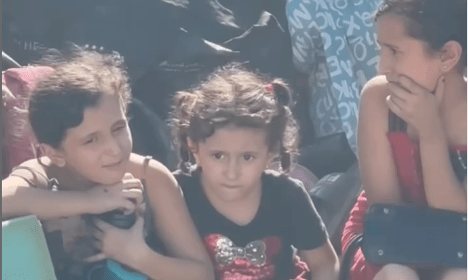
Blankets and dollars for Gaza. Here is one of the most effective places to send aid to the children and families in occupied Palestine
Children in Gaza ride in the open bed of a truck with water and all their possessions.
Help Gaza survive this winter by donating to @projecthopepalestine. Part of the Taxpayers Against Genocide family of humanitarian efforts that go hand in hand with ending the illegal funding of genocide in Israel/Palestine.




 Davisite